Saturday, September 17, 2011

ThoughtsXI
(Sorry to burst your bubble but that is not piaff)
by Chazot
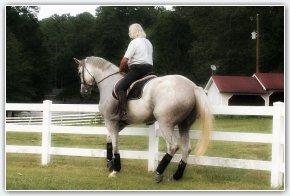


Often at the end of the day, Helyn and he bring out two chairs and drinks and sit between Manchester’s pasture and my turn out and watch us. This is a time of peace where we all enjoy each other’s company. Even the kissing machine is resting. Bretelle is a boxer with a tongue longer than his body. He is the gentlest dog on earth but he always tries to kiss us. You cannot imagine the length of his tongue. I lift my nose a few inches thinking that I am out of reach and within the next second I have half of his tongue deep inside my nostril.Sometimes, Helyn and he are engaged in a long conversation. Other times they stay silent listening and watching. Yesterday, Helyn brought a photo that she took earlier during our training session. She walked toward me showing the picture. I remember the trot departure. I felt I was in good balance and succeeded in a departure quite collected.  noticed the position of my legs on the picture thinking that it almost looks like piaff. This is when hethinks, Sorry to burst your bubble but that is not piaff.

I was shocked. I am supposed to be the one who can read his thoughts. He is not supposed to know mine. I knew that this was not piaff. I was simply playing the game of many riders who are using pictures, which look like piaff to burst their ego. Mostly to verify if he really can read my thoughts I pushed the issue insisting that may be it was not a true piaff but it was close.He scared me, as he thought, “Not even close. The picture was taken at a good time and your legs may appear to be doing piaff but the synchronization of your back and legs is not correct. Your supporting hind leg is on the pushing phase. If you were at the piaff, it would be in the braking phase. I said to Manchester, he really knows what I think. Manchester disagreed. I don’t think so. He does not even believe in animal communicators. Your former owner was a so-called animal communicator and she never had any clue of your emotions, suffering and thinking. Let me tell you what I think is happening. My belief is that when his brain is on a subject, he explores further and further. I think that he is following his own thoughts and it just happens that his thoughts appear to answer your questions. In fact; I see there the potential for some juicy exchanges. Ask him about subjects unrelated to horses.

I asked then, what do you think about the catwalk of fashion show models. His thought was, bad judges can only see the legs action. They cannot see higher. They do not understand the biomechanics of the vertebral column. Manchester and I smiled thinking this one was not too bad. As he was thinking about the riders during piaff, I asked, what do you think about the members of congress? “They shake their butt back and forth to keep the momentum going. If they were using their brains instead, the performances would be much better.”Manchester and I were now laughing. This one was not bad at all. He was thinking about training techniques activating the horses’ hind legs with a dressage whip and I asked, what about the tea party? “You can brandish a long whip as much as you want, this does not awaken a dead brain.” Manchester was ecstatic. Then I asked, what about the horse whisperers? “It is always the ones who are doing the worse things behind the curtain that are presenting themselves as sweet and compassionate.” Manchester and I decided that this one was not humoristic but dead accurate. I tried French politics. [Image]What do you think about the wife of the French president? “Beautiful.” I froze then started to sweat. I told Manchester, this was a not coincidence. This was a direct answer to my question. Manchester told me Look, he is looking at his wife.

The next day, we had one of these interesting sessions that demands high concentration and muscular work. Shortly after his arrival, Manchester commented on one of these sessions. I don’t understand why you sweat so much, you were doing nothing. You were going slowly at the walk and at the trot. There was no half pass, no shoulder in or medium trot. The whole session was boring to observe. It was like watching the grass growing. I remember that I was annoyed and decided that he needed a strong repartee. Listen to me miniature horse, you are not going to execute compulsories with a dysfunctional body. You are not going to run through the ring, completely off balance over your front legs and leaning heavily on the rider’s hands. You are not going to be submitted to meaningless cues such as half halt. Instead, you are going to learn the mastery of balance. You are going to learn how to control accelerations of gravity and other forces through your vertebral column and limbs kinematics. You are going to learn the athletic angle of balance and body control. You are not going to repeat movements until your body is properly coordinated for the effort. You are going to become a functional athlete. You are going to use your physique like you never did before and this is why you will be sound for the first time in your life. Manchester stayed silent for a while.

Later, he came back to the subject adding, In my world it was all about executing the movements. No one ever considered how our physique was supposed to be coordinated for the move. I told him, in my racetrack world, it was even worse. Often I wonder if they were the same human species. We used to call them Homo-retractus. They are smaller and they retract their legs like cats retract their claws. When they walk, their legs have normal length but they retract them when they ride. Basically our education was about exploiting our talent without much consideration and study about how our physique does produce speed.

They push us to go faster and faster until we break down. In fact, even when we break down they continue to push us. Early in my training, I had a fracture of the posterior lateral wing of my coffin bone. They did not explore the thought that I was too tall and too heavy for speed. They gave me some rest and restart again. This was the thought that crossed immediately his mind whenhe saw me for the first time. This is when I realized that I was able to read his thoughts. He looked at me from the side thinking what the hell are those people thinking? How could they even imagine that a horse with such size and mass could be successful on the racetrack? He must have enormous growing issues. He does not have the muscular development to deal with his mass. I wonder how he managed to remain sound. I liked him for that. It was the first time someone had some empathy for my physical difficulties. Everybody else was criticizing me and punishing me for my lack of performance.
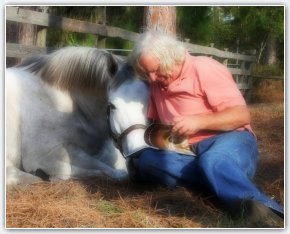


I remember that later, he sat on the grass next to me as I was taking a nap. He was reading a study about speed on the racetrack. At speed, better horses have two fly periods during a canter stride. [Image]A normal canter stride is traditionally outside hind leg first. Then comes the diagonal sequence, inside hind leg and outside foreleg, which is followed by the support of the inside foreleg and up into the fly period. Better horses add a second fly period during the diagonal sequence, between the impact of the inside hind leg and ground contact of the outside foreleg. There are even exceptional horses which add a third fly period between support of the outside foreleg and alighting of the inside foreleg. He was thinking, how could we educate a horse to develop a second fly period during the diagonal sequence? The fact is that if such education was possible, racehorses could go faster. He developed in his mind a working hypothesis where it would be possible to create the phenomenon. But he dismissed the thought thinking that while possible such education would require too much time and knowledge. The racing industry is about quick money.

I started to realize the extent of his work. Scientific studies do not come as formulas ready to be applied.
He summarizes quite well the problem referring to the concept of ease. He often states, If the horse is properly coordinated for the effort, the performance is effortless, starting with the gaits. If the rider struggles while sitting the horse’s trot, the horse is not properly coordinated for the trot. The horse is controlling balance using the braking phase of the front legs instead of their upward propulsive activity. I experienced this phenomenon yesterday. He was away for four days and my exuberance became out of control, I rolled frantically hurting my spine in the cranial thoracic area. It was a little uncomfortable but I did not realize how much I overdid until he rode me. His weight on my back awakened the muscular pain and when he asked me to trot for the warm up, I tried to use the effect of my nuchal ligament I lowered the neck pushing on the bit. Doing so, my nuchal ligament exerted a pull on the dorsal spines of my whither. This creates a lift of the whither area but also a rotation that is shifting the weight over the forelegs. I was too heavy on the forehand and when I went into the trot, I controlled my balance braking with the forelegs instead of propelling my body upward. It was quite uncomfortable. He halted me immediately realizing that I had a muscular issue. The rest of the training session became a physical therapy session designed to release the tension of my back muscles. It took a little more than 30 minutes at the walk but he worked my body until the muscle spasm vanished. We went then for another 30 minute walk outside.

He never let me trot heavy on the forehand and leaning on the bit, so I forgot how uncomfortable the trot can be when I am not properly coordinated for the effort. I feel great since. I had a comfortable night in my thick layer of shavings and today I was capable to further the coordination of my back muscles. Maybe I need to explain to you how this technique works from my perspective.

First of all, he never disturbs my back muscles shifting his body weight back to front or front to back. I do appreciate his stability. When the rider shifts his or her body weight back to front or front to back, the rider movements disturb our vertebral column mechanism. [Image]We then have great difficulties to properly coordinate the action of our back muscles which are situated in mirror image directions. Our capacity to resist gravity and therefore achieve balance control demands precise coordination of these muscles down to the fascicles that compose these muscles.

The second point is that when we are working at the walk or the trot or at the canter, his vertebral column barely moves. I do appreciate the moderated range of motion of his vertebral column because his movements are in harmony with my range of motion. Especially in the dorso-ventral direction, my vertebral column does have a very limited range of motion. He seems to have understood the phenomenon since his vertebral column moves within the same range of motion as mine. Basically, we are dancing the same subtle and discreet dance.Then, he asks me to refine my straightness. I mean more straight than straight. A better description would be that he asks me to move within the limits of a very narrow corridor. This demands a very sophisticated body control. At the walk as well as at the trot, our vertebral column executes alternative lateral bending which are synchronized with the legs actions. In fact, our limbs are creating lateral bending of our spine and our spine is controlling and even resisting this lateral flexion in order to convert the thrust generated by the hind legs into forward movement. The faster we go the more we need to reduce those lateral flexions. Any lateral flexion is always coupled with a movement of transversal rotation, which occurs in the first half of our thoracic vertebrae. Transversal rotation induces longitudinal flexion and this is how it works. He is asking me to move so straight that I have to reduce the amplitude of my vertebral column’s lateral bending. The most efficient way for me to do that is to increase the longitudinal flexion of my spine. You have to understand that I am here describing what I am doing in terms of kinematics, which is the geometry of movements, when in fact I am working at a dynamic level. I am controlling, redirecting and modifying forces. The problem is that it is difficult to describe forces with words. When I say longitudinal flexion of my spine, naïve equitation thinks about a vertebral column becoming round like an arc. In fact, the geometry of my vertebral column barely changes. What I am doing is converting the thrust that I produce with my hind legs into horizontal forces, which are basically forward movement, and vertical forces that are allowing greater balance control.

I did not immediately figure this advanced way to coordinate my vertebral column mechanism. I first responded through natural reflexes. I rushed forward, I leaned on the bit, I moved my shoulders sideways, I shifted my croup to the right or to the left. He quietly asked me the same question; can you move straight, slowly, maintaining some activity of the hind legs without leaning on the bit. In fact he was using my errors to provide me more accurate insights. He helped me by guiding my brain toward the most efficient coordination of my vertebral column mechanism. Every time I feel simultaneously great control and great ease, he rewarded me. I already knew that I was good because it was effortless for me. His reward was simply reinforcing a feeling that I already liked. I am glad that he did not rush me forward. It would have been very difficult for me to concentrate and explore my own body beyond the limits of my natural reflexes if I had to deal with very strong activity of my hind legs. However, he is now asking me to maintain such advance control while increasing the propulsive activity of my hind and front legs.
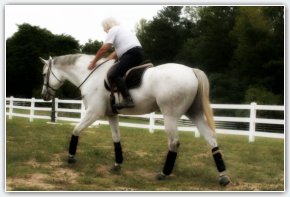
In fact today, it was a moment where I was feeling such an easy control of my balance and power than I wanted to pick up the trot and show him how close I was to the piaff. Instead heasked me for a square halt. He patted me and let me walk on long reins. His thought was then, You know, during this last coordination that you put together before we stopped, you were much closer to the piaff than you were when you were shaking your legs in cadence.
Chazot Edited by Susan HopfAuthor Jean Luc Cornille copyright 2011 all rights reserved References(1) www.scienceofmotion.com

(Tensegrity and mechanoregulation: from skeleton to cytoskeleton, Christopher S. Chen and Donald E. Ingber, Osteoarthritis and Cartilage, 1999. &, 81-94)-94)

Wednesday, September 14, 2011

Thoughts V
by Jean Luc Cornille 2011
www.scienceofmotion.com

Active learning emphasizes the positive effect of individual control over learning. For instance while the driver of a car may easily remember directions, (active learning,) it might be difficult for the passenger to learn a route, (passive learning). I have to say that when I am in the trailer, I never remember the route. In fact, he does not either, even when he is driving. Once, he loaded me in the trailer, drove 15 or 20 minutes and stopped practically at the same spot in the farm that we were when we started. He tried to say that this was a loading exercise but I believe that he was just lost.


Sometimes, he comes in the barn with his laptop, sits in front of my stall door and works on a study. I was looking over his shoulder and read, hippocampal. In French language, a hippocampe is a seahorse. Then I read volition, and I was deeply puzzled. Why is he reading a study about a seahorse playing the violin? I realized then that I was thinking like a typical horse person. I was not reading to further my knowledge, I was reading to find confirmation of what I believe. I was critical of every word or thought that I was not familiar with. The study was about humans’ and animals’ brain learning process. The hippocampal is a part of the brain involved in memory encoding andvolition is about voluntary control in the process of learning.


After the first page, my brain was swelling and I decided that it was time for me to munch a little bit of hay. I noticed that the fingers of his left hand were pressing against his left temple. Usually, he does that when he is highly concentrated. I know this because he does that when I puzzle him during a training session. He ended his reading thinking, whoa! Even for animals, volitional control benefits memory performance. Now he was telling me, do you know that engaging your intelligence instead of seeking obedience increases your learning capacity by 22%. I told you; sometimes he really annoys me. Of course I know that I learn faster when he stimulates my mental involvement. This is the way we work together everyday! Then, he literally verbalized my thoughts, “I know that this is exactly how we are working together every day, but this is now scientifically explained”.


In the protocol of the scientific experiment, a different approach referred to as deterministic, was more like submitting us to a system such as the order of priorities emphasized into the pyramid of training. Such an approach did not enhance memory performance. In fact, I doubt there is even one single horse in the world that would agree with the fact that imposing a given order of priorities, such as forward before balance, collection before straightness and so on, would accomplish anything other than to lead us into our grave rather than all the way to the top of the pyramid.


For instance, the common practice on the racetrack is to race in fourth or fifth position. The thought is to save energy during the race and be at the right place for the final sprint. They applied this strategy with me without ever considering my size and lack of muscular development. I struggled out of the starting gate. I had a hard time during the accelerating phase. They should have focused on my muscular development. Instead, they attempted to fit my unusual size to their system. Their racing strategy was conventional but totally ill adapted to my physique. They should have let me race behind and increase the speed progressively. Instead, they gave the order to the jockey to beat me from the beginning of the race. I reached the fourth position but I collapsed half way through the race completely out of strength.


Manchester retorted, same for me. They submitted me to their training scale without analyzing my anatomy and weaknesses. I read somewhere that, “Kyphosis was most frequently seen in young horses exhibiting varying degrees of bilateral stifle damage. Improvement only occurred if the underlying cause was resolved.”(1) I am practically born with a kyphosis and I have had many stifle problems, principally the left one. The underlying factor was the way I was using my vertebral column and not one trainer, until him, ever adapted their training scale to my physical peculiarity. They were not bad riders but they only knew one system and they all tried to fit me to the training technique that they where familiar with.


Quite frankly, the thought that all horses should be submitted to the same training scale is primitive. However, when it comes to the pyramid, I do not have much of an opinion; I have never been ridden by a pyramid.


Not only does volitional education further our learning capacities but active learning is, in fact, the sole approach that can direct our central nervous system, and in particular our brain, toward the body coordination precisely adapted to the athletic demands of the performance. Considering the forces that are induced in our vertebral column and limb structures, the magnitude of the misconceptions ruling our traditional education is disconcerting. Let’s talk about stretching and relaxation for instance. When I look to be at ease and responsive I am ready to perform any task he is asking me, I am activating my support muscles at all time. I am not relaxing them at all.


Sometimes during a training session, as I return to bad habits, he tells me, “To discover something new, you must be willing to loosen your grip on the old.” (Michael J. Gelb). I think that it is now my turn to give you the same advice. You will not understand how volitional education works if you think that our vertebral column and legs function the way the old style idea does. We do not create movements lengthening and shortening our back muscles. In fact, riding and training techniques attempting to increase such lengthening are forcing our back muscles to work in a dysfunctional way. I have often heard that long before I was born, scientific studies had exposed that the main function of our back muscles was to preserve the integrity of our vertebral column’s structure while allowing a little range of motion. My ancestors were hoping that finally, advances in scientific knowledge might redirect riding and training principles toward systems adapted to our physiology. Instead, and under the name of tradition, we are still submitted to training techniques in plain contradiction with the way our muscular system operates.


Of course, it is easy for me to explain how our muscles work since I feel each word I say. Let start with the most recent discoveries and then go back for clarity to older ideas. With the twenty first century, advanced research studies are referring more and more to theplasticity of muscles function. The concept does explain quite accurately how our muscular system operates.


For instance some muscles have a simple structural design, (sarcomeres in series, long muscles fibers and few connective tissue insertions,). These shorten when in contraction. This kind of muscle architecture can generate power; the power to move a joint during locomotion when the muscle is attached to the bonds through stiff tendons. The stiffness of the tendon is necessary to transmit power. As it is easier to visualize muscles and tendons of our lower legs, this architecture is the way our deep digital flexor muscles and tendons are built.


Even if this is what everyone tends to think, this concept relates to a fraction of what our muscles are really doing. Our main problem as equines is to save energy. We are massive creatures capable of sustaining a relatively high speed and for a long period of time. We owe our survival to such capacity. Given enough warning, we can outrun all of our predators. Some can sprint faster than us but only for a short period of time. Down to the cellular level, our adaptation (to what has been our survival imperative when we were wild animals) is about producing maximum power at minimum muscular energy cost. The simple type of muscle work that I described above is not cost effective. A much more efficient but also much more sophisticated muscular work is widely used throughout our body.


Our force producing muscles have a different architecture. They have sarcomeres in parallel, short fibers and many complex connective tissues compartments. They operate in isometric contraction, which mean that they do not lengthen or shorten. They just hold allowing their compliant tendons to be loaded with elastic strain energy. This is how our superficial flexor tendons and muscles function. In terms of energy, it is much more economical for a muscle to not shorten and instead let the tendons do the job. If our muscles are elongated while active in isometric contraction, the force produced is almost double the isometric force. This type of contraction is called eccentric contraction. It does happen quite often that during a movement, our muscles move into eccentric contraction to deal with a brief instant of particular intensity.


The problem is that our muscles can only lengthen 1 to 2% of their neutral length. Most of our back and hind leg problems result from asking the wrong type of work to our muscular system. I never had personally to deal with any stretching theory. On the racetrack the focus is speed and we create speed by stiffening our vertebral column’s muscles. By contrast, Manchester does know about the stretching business and he does not have anything good to say about it. My riders were asking me to increase the swinging motion of my vertebral column. They obviously did not know that the large majority of our back muscles can only lengthen a little. I guess, their misconceptions were the reason why riders, who otherwise were kind with me, were forcing me to work into a painful manner.


However, as accurate this explanation might be, it is also incomplete. The description makes it look like we are turning our muscle cells on and then, allowing the elasticity of our tendons do the job. I have more control than what is suggested in this theory. I have the capacity to utilize the thrust that I create with the hind legs for more balance control or more speed. I can even nuance quite subtly the work of my back muscles. Part of this control is inherent and part is learned. I guess more studies are necessary and in a few years humans may finally get it right.


Even within the limits of today’s knowledge, I do like the way he is applying scientific discoveries. He is guiding my brain toward advanced control of my physique. He is referring to volitional learning. I do like the mental activity and definitely the physical comfort that is associated with every move I am making.


Long before I was born, a Polish scientist theorized that each one of our vertebra does have the capacity to convert the thrust developed by our hind legs into horizontal forces, which are moving our body forward and vertical forces, which are resisting attraction of gravity. Heknows the study by heart and once he was thinking about the way the Polish researcher formulated his findings, “An initial thrust on the column is translated into a series of predominantly vertical and horizontal forces which diminish progressively as they pass from one vertebra to the next”. (2) I was ready to argue with the finding since I do not feel that I have control of each individual vertebra, but his next thought becomes more familiar. Tucker does not pretend that the horse does have perfect control of each individual vertebra. This was his investigative technique. The thought is that the main muscles of the vertebral column are capable of creating horizontal and vertical forces through the rotary systems of the vertebrae. Later, the thought was furthered with the work of an American pathologist named James Rooney. More recently, a French Professor named Jean Marie Denoix provided a comprehensive explanation of the way the vertebra rotate in relation to each other. The school of thought that dominated equine research of the twentieth century believed that a muscle has concentric (shortening), isometric (stay same length) and eccentric (stretching) contractions.


With the twenty first century, the knowledge is that the three types of muscle contractions effectively happen but at the level of the individual muscle fibers, not the muscle as the complex tissue. I was amused to see him thinking intensively about these findings when for me they were quite obvious. For us equines, the work of our vertebral column is much more dynamic than kinematic, which mean, that we are converting and redirecting forces much more than we are creating movements. However, it does look like riders have a different perception. They tend to interpret forces as movements.


I like to test my thoughts on Manchester. He listened to my explanation and then played with my sensitive string. Not bad for a thoroughbred. I was ready to question his warmblood’s superiority complex but he was already furthering his thoughts. Maybe you have a point there. The more riders try to understand how our muscular system really operates, the more likely they will move away from gross practices such as shifting their body weight and trying to stretch our back through lowering of the neck. Hopefully they will also question fundamental principles of their training scale, such as stimulus response, reward and punishment, correct aids equal correct movements. All along their history human artists, scientists and philosophers have emphasized the need for evolution but they have a hard time to loose their grip on old habits. Leonardo da Vincy, who created the Sforza equestrian model, which is a beautiful horse, that looks very much like me, insisted on questioning conventional wisdom. By the way, do you know that Leonardo was a good rider? Quite obviously I interested Manchester since he rarely talks with his mouth full of hay. What I like with modern understanding of our vertebral column’s muscular system is that it becomes quite obvious that only our central nervous system and in particular our brain, can efficiently coordinate such a complex mechanism. Perhaps, instead of annihilating our brain through dim obedience, our riders may realize than a true partnership would generate better performances while giving us a chance to remain sound. Then he swallowed his last bite and dropped the head for another full mouth of hay. I was thinking that such was his last words but he raised his head again and asked, do you know that I am a “dumbblood.” I looked at him incredulously and he added; this is the way they call us when we are not performing as they wish. The amusing side of the story is that they don’t know that in our world, the dumb is the rider and the blood is the horse.

Manchester makes me realize that I was effectively involved into volitional learning. He is placing me in the driver’s seat. He is actively engaging my brain and body and under his guidance, I am capable to process body synchronizations that I could not have put together by myself. The misconception that has run equine athletic training since centuries is that performances are the outcome of natural reflexes or genetic behavior such as pecking order, etc. We do not know by birth how to most efficiently carry a rider, shorten the stride between the two elements of a jumping combination, or execute a canter pirouette. We bring our talent to the specialty, but our skill does not include advanced knowledge of the performances’ athletic demands. If our education is limited to judging standards we perform at the best of our natural reflexes until lameness ends our career.


He teaches me for instance how to flex my back longitudinally. The equestrian education refers to this coordination as a round back. In fact, our vertebral column is never really round. The expression round back is a metaphor. As we convert through the biomechanics of our vertebral column, the thrust generated by the hind legs, which is basically a force in the direction of the motion, into vertical forces, which are resisting gravity, we are giving to the rider the feeling that our back is becoming round. We are creating through the biomechanics of our vertebral column, a dynamic phenomenon, (forces), that riders interpret as a kinematics phenomenon, (movements.)


He does not try to round my back via neck posture. Instead, he guides my brain toward greater conversion through my back of my hind legs’ propulsive activity into vertical forces, which are resisting attraction of gravity. I would never have thought of “rounding” my thoracolumbar column the way he taught me but I can feel that his solution gives me greater ease and much more advanced control of my body. Basically, he is guiding my brain to create muscular coordination eminently adapted to the performance but beyond the scope of natural reflexes.


He never shifts his body weight back to front or front to back. Instead, he always keep is body in neutral balance over his seat bones. This allows me to concentrate on his vertebral column’s movements. He reduces his vertebral column’s motion until he perfectly matches the amplitude of my vertebral column movements, which is extremely reduced. Once we are moving in harmony, I naturally make adjustments preserving such harmony, as it is more comfortable to dance the same dance. In order to stay in harmony with minute motions of his vertebral column and nuances in tone of his back muscles, I orchestrate into my brain, the many and minuscule contractions, compensatory contractions and nuances in the tone of my back muscles.


Via memory, I do have the capacity to associate voice commands or gestures with a given movement, but this type of education does not coordinate my physique athletically for the performance. On the contrary, the subject of our conversation is about coordinating efficiently my body for the athletic demand of the performance. I am particularly comfortable with the subtlety of the dialogue. Humans whose brains are lacking tend to bully us through heavy rein actions and large spurs. In reality we have a very high sensitivity level and the kindness and subtlety of his body language makes me feel safe and comfortable. I do not have to protect myself from aggressive or excessive movements.


If you judge a fish by its ability to climb a tree, it will spend his whole life believing that it is stupid.” (Albert Einstein) Forcing us to perform with a dysfunctional physique, the equestrian education shatters our athletic abilities and self-confidence. Until now, Manchester believed that he was a dumbblood. He was submitted to a system that was not adapted to his physique and his mind gradually believed that he was stupid. Manchester is a quiet thinker who process information over night. One evening after work, he was taking care of Manchester. He patted Manchester on the neck telling him; that was pretty good. Think about it and you will find an even more efficient way. Manchester did think about it all night. He did not even eat all of his hay, which for Manchester is very unusual. The next day Manchester achieved his firsts sound steps telling me I can’t believe that I was capable to achieve such body control. He is the one who stimulated my brain and from simple thought to more complex ideas, I realized that I was capable to think further than I was trained to believe. He is teaching me to think and the more I use my mind, the greater I can control my physique.


One night Manchester summarized the situation. You have an almost perfect physique, so your brain can focus on finding the coordination allowing great performances. My body is less than perfect and my brain has to work as hard as yours simply to move soundly. I do not question the unfairness of life. I am proud of what I am doing as well as what you are doing. I told him, you are the philosopher of the family and knowing how your mind works, I often think about Edsger Dijkstra’s reflection; “Why has elegance found so little following?”

Chazot


(1) (Leo B. Jeffcott, Disorders of the thoracolumbar spine of the horse – a survey of 443 cases. Equine vet. J. 1980, 12, 4. 197-210)

(2) (Richard Tucker, Contribution to the Biomechanics of the vertebral Column, Acta Thoeriologica, VOL. IX, 13: 171-192, BIALOWIEZA, 30. XL. 1964)